Hole Em All: Black Hole Games
- 4.8
- Rating
- 10.00M
- Installs
- Free
- Price

 Analysis by App-foxy
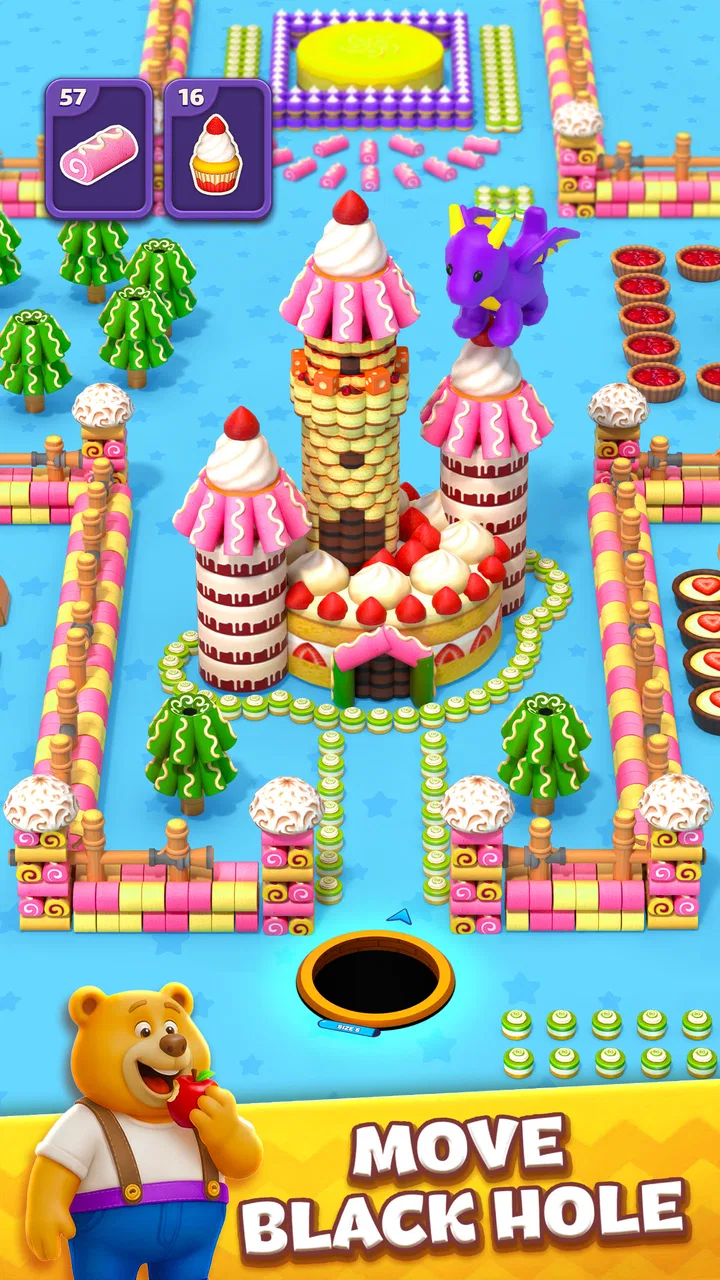
I spent my time with Hole Em All: Black Hole Games mainly for one reason: its central idea is wonderfully easy to understand. You drag a black hole around the screen and use its pull to clear objects, open a path, or solve the puzzle in front of you. That single capability gives the game its identity, but it also creates more depth than the short description suggests. The important question is not simply where to move the hole; it is when to move it, what to collect first, and how to avoid turning a good position into an impossible one.
This is a free puzzle game from BRAINWORKS PUBLISHING PTE. LTD., aimed at Everyone. It has already attracted over 10 million installs and holds a 4.9 average from around 156 thousand ratings, which makes its broad appeal easy to understand. I can see why it works as a quick, casual distraction, although I also noticed limitations that matter if you are looking for a deep puzzle experience rather than a relaxing game built around one satisfying mechanic.
Why dragging the black hole is the whole point
The black hole is not just a visual theme placed over an ordinary puzzle. It is the tool you use to interact with almost everything that matters. Instead of tapping matching pieces or moving a character through a maze, I guide a growing opening across the play area and decide which objects should disappear first. The result feels immediate: a small movement can change the entire board, and a well-planned sweep is much more rewarding than random dragging.
You May Also Like

 Blood Strike: 2.5 Anniversary
Blood Strike’s Loadouts Turn Every Drop Into a Tactical Gamble
A close look at Blood Strike’s custom loadouts: how fast access to signature weapons reshapes its battle royale rhythm, rewards preparation, and narrows the gap between fights.

 Pandora - Music & Podcasts
Pandora’s Music Is Easy to Start, but Harder to Recover
Pandora’s strength is its low-effort path from a seed to a station. Its weak spot is how much confidence it asks you to place in connection, setup, and quiet recovery.

 8 Ball Pool
 Is Built on Rivalries, Rematches, and Routine
A close look at the rivalries, rematches, shared routines, and unanswered safety questions that turn a quick pool match into a persistent mobile community.

 Samsung Music
’s Quiet Strength Is Playing What You Already Own
Its reach comes less from spectacle than from dependable access to a personal library. That simplicity is both the app’s strongest retention engine and its ceiling.

 AccuWeather: Weather Radar
AccuWeather Review: A Quick, Clear Forecast for Everyday Decisions
For everyday plans, the best forecast is the one you can understand quickly. AccuWeather makes rain timing, radar, and local conditions easy to act on, with a few trade-offs.

 Hill Climb Racing
Why Hill Climb Racing Still Turns Crashes Into One More Run
A tiny car, a bumpy hill and one more upgrade: Hill Climb Racing keeps resurfacing because its simple chaos makes every near-miss feel personal.
More From Our News Desk



What makes this capability interesting is the tension between control and momentum. At first, I wanted to move quickly and collect whatever was closest. That worked for the simplest stages, but later decisions felt better when I paused to read the layout. A tempting object can block access to another one, while a careless route can leave an awkward corner untouched. The puzzle is therefore less about speed than about arranging the order of your actions.
I particularly like that the mechanic is readable without a long explanation. A new player can pick it up almost immediately, yet there is still room to improve through observation. That makes it suitable for short sessions, including the kind of five-minute break where I do not want to learn a complicated control scheme. The interaction is also more tactile than a typical match-three board because I am physically steering the main puzzle element instead of selecting isolated tiles.
There is a useful difference between solving a level and merely moving around it. The fastest-looking route is not always the safest. When I treated each object as part of a sequence, the game became more thoughtful. I began checking the edges of the area before committing to a sweep, watching for spaces that might become difficult to reach, and using the black hole’s position as a way to prepare the next move. That habit is one of the game’s quieter strengths.
How the control feels during ordinary play
In practice, the control is best when I make short, deliberate drags rather than broad gestures. Small adjustments let me line up the hole with a cluster and keep the route under control. Long movements are satisfying when the board is open, but they can also make me overlook a leftover object or pass a useful position. My most reliable approach was to divide the board into areas, clear one section, then reposition before crossing into the next.
This creates a simple workflow that is easy to remember. I first scan the full layout, then identify the objects that appear to define the route, and only afterward start collecting. If I rush straight toward the largest group, I sometimes lose the clean angle needed for the remaining pieces. That is not a complicated strategy, but it changes the experience from casual swiping into light spatial planning.
The mechanic also gives the game a strong visual rhythm. A successful movement usually produces an obvious result, so I do not need to wonder whether an action worked. That feedback is useful for younger players and for anyone who prefers games that communicate through motion rather than dense menus. The Everyone age rating fits that approachable presentation, though adults who want demanding logic problems may eventually find the basic interaction too familiar.
One practical tip is to avoid treating the center of the board as automatically safe. I found that edges and narrow spaces deserve attention before I make a large sweep through the middle. Clearing the obvious central group can feel productive, but it may leave small targets in locations that are harder to approach cleanly. Looking for the least convenient object first is often more effective than chasing the most visible one.
Another useful habit is to pause after a successful collection rather than immediately continuing the same drag. The board may now offer a better route, and the black hole’s new position can make the next move easier or harder. This brief reset helps me avoid accidental overcorrection. It is a small distinction, but it is where the game’s main capability becomes a puzzle tool instead of a simple animation.
The best everyday scenario for this game
For me, the strongest use case is a short break when I want something interactive but not mentally exhausting. I can open it, solve a few boards, and stop without needing to remember a long story or maintain a complicated build. It works well when I am waiting for an appointment, taking a break from work, or winding down before bed and want more involvement than watching a video.
It is also a reasonable choice for sharing a device with a child because the basic objective is visible and the controls are straightforward. An adult can explain the idea in a few seconds, then let the player experiment with movement and order. The puzzle structure encourages looking ahead, but it does not demand advanced reading or a large collection of separate rules. That accessibility is one reason the game can appeal across age groups.
My advice for a first session is not to chase perfect speed. Instead, use the early boards to learn how the black hole responds to direction and how much of the area can be covered in one controlled movement. Once that feels natural, start planning around the awkward objects rather than the easy ones. This makes the transition to more thoughtful play smoother and prevents the game from becoming a sequence of uncontrolled swipes.
It is less suitable for a commute where you need to stop instantly after a few seconds, especially if you dislike leaving a puzzle unfinished. It is also not my first recommendation for someone who wants a narrative campaign, competitive ranking, or a highly complex logic system. The appeal is concentrated in the physical act of dragging and the small decisions surrounding it. If that core interaction does not feel satisfying, the rest of the package is unlikely to change your mind.
Where the trade-offs become noticeable
The biggest trade-off is repetition. The black-hole mechanic is enjoyable because it is clear and tactile, but the same clarity can limit variety over a longer session. I had more fun when I played in short bursts than when I tried to push through many puzzles at once. The game benefits from being treated as a compact snack rather than an all-evening challenge.
There is also a difference between visual satisfaction and serious difficulty. Watching objects vanish is pleasing, and the board-reading element gives the game some thoughtfulness, but players accustomed to intricate deduction puzzles may want more layers. I would describe the challenge as accessible spatial planning rather than a demanding brainteaser. That is a strength for casual users and a possible weakness for puzzle enthusiasts seeking constant escalation.
The free entry point makes it easy to try, but the game includes in-app purchases ranging from $0.99 to $119.99 per item. I would personally approach those purchases carefully and decide first whether the core loop remains enjoyable without spending. The presence of optional purchases does not change my view of the dragging mechanic, but it does mean families should be aware of the purchase range before handing over a device.
Another trade-off is that the game’s simplicity can make the first impression stronger than the long-term commitment. The opening interaction is immediately understandable, which is excellent for accessibility. However, players who need a constant stream of new rules, characters, or systems may feel that the central idea carries too much of the experience. I would choose it for quick puzzle sessions, not as my only game.
The current version is 1.10.1 and it requires Android 8.0 or later. That makes the compatibility question fairly straightforward for Android users: check the device’s operating system before installing, especially if the phone is older. I would not choose a game like this as the deciding reason to upgrade a device, but on a compatible phone the low-complexity control should make it comfortable for a wide range of players.
How it compares with familiar puzzle alternatives
Compared with match-three games, this feels more physical and less dependent on spotting color patterns. I am not building a chain by tapping individual pieces; I am shaping a route through space. That makes it a better fit when I want movement and positioning, while a traditional match-three title may be better when I prefer quick combinations and frequent cascading effects.
Compared with block-placement puzzles, the game asks me to think about access rather than arrangement. I am not constructing a stable shape or filling a grid. The key decision is which area to approach and how the black hole’s position affects the next collection. Someone who enjoys planning several placements ahead may prefer a block puzzle, while someone who likes direct interaction may find this more immediately rewarding.
Compared with physics-based puzzle games, it is easier to read because the main action is so focused. There are fewer layers between intention and result: I drag, the hole moves, and the board responds. That simplicity is useful for casual play, but physics fans who enjoy unpredictable chains or elaborate contraptions may find it restrained. The game’s satisfaction comes from clean routing, not from building a complicated machine.
That comparison helped me understand its proper place. It is not trying to replace every kind of puzzle game. Its best quality is the narrowness of its idea: one unusual tool, one clear interaction, and a series of decisions about using it well. When I accepted that scope, the game felt more coherent and easier to recommend to the right person.
Who will get the most from the black-hole mechanic
I would recommend it to casual puzzle players, families looking for an accessible game, and anyone who enjoys satisfying visual feedback from simple actions. It is especially good for people who like to improve through small adjustments. You do not need to memorize a large rulebook; you need to notice routes, think about order, and control your movement with a little patience.
It can also suit players who normally avoid puzzle games because they seem too abstract. The objective is represented directly on the screen, and the black hole gives every action a physical feeling. Instead of solving a problem entirely in your head, you can test a route and learn from the result. That makes the game inviting even when your usual preference is arcade-style interaction.
I would skip it if your priority is deep strategy, a story-driven adventure, or a competitive experience with long-term progression. I would also be cautious if you are easily bored by repeated use of one mechanic. The game’s value depends heavily on whether dragging the black hole remains enjoyable after the novelty fades. For me, shorter sessions preserve that enjoyment better than extended play.
One final practical suggestion is to use the game as a focus reset rather than background entertainment. Before each puzzle, spend a moment identifying the hardest-to-reach area. Then make that area part of your plan instead of clearing only what is convenient. This turns a few casual minutes into a small exercise in visual planning and gives the simple controls more purpose.
Overall, I find this puzzle game easy to recommend when the goal is accessible, tactile fun. Its strongest capability is not merely that the black hole moves; it is that every movement asks me to balance immediate satisfaction against the next position. The experience is free to start, suitable for Everyone, and popular enough to have passed 10 million installs, but its real appeal is more personal: it gives me a clear little problem, a responsive tool, and just enough room to make a better decision on the next attempt.
My final view is positive with a clear qualification. I would keep it installed for short breaks and relaxed puzzle sessions, especially when I want something more active than scrolling. I would not rely on it for demanding long-form puzzle depth, and I would keep the in-app purchase range in mind before spending. If you enjoy guiding objects through space and learning the value of route order, this is a charming choice; if you need constant novelty, another puzzle category will probably serve you better.
FAQs for Hole Em All: Black Hole Games
01What is the main objective of Hole Em All: Black Hole Games?
Hole Em All: Black Hole Games is a captivating puzzle game where the primary goal is to strategically maneuver a black hole to consume all objects on the board. Players must use their wits and timing to clear each level, making it both challenging and entertaining. The game tests your puzzle-solving skills and reflexes.
02Does Hole Em All: Black Hole Games offer in-app purchases?
Yes, Hole Em All: Black Hole Games includes in-app purchases that allow players to enhance their gaming experience. These purchases can range from additional levels and boosters to cosmetic upgrades. While the game is free to download and play, these optional purchases can offer a more enriched experience.
03Is Hole Em All: Black Hole Games suitable for children?
Hole Em All: Black Hole Games is designed to be family-friendly and suitable for players of all ages. The game features a simple and intuitive interface, colorful graphics, and non-violent gameplay, making it an excellent choice for children. Parents can feel comfortable allowing their kids to play without supervision.
04What platforms is Hole Em All: Black Hole Games available on?
Hole Em All: Black Hole Games is available for download on both Android and iOS platforms. Whether you are using a smartphone or a tablet, you can enjoy the game seamlessly across different devices. Check the Google Play Store or Apple App Store for compatibility with your device.
05How often does Hole Em All: Black Hole Games receive updates?
The developers of Hole Em All: Black Hole Games are committed to enhancing the player experience by providing regular updates. These updates often include new levels, improved features, bug fixes, and occasional special events. Players are encouraged to keep their app updated to enjoy the latest content and improvements.
Pros
- Intuitive controls make it easy to play.
- Visually appealing graphics and design.
- Variety of levels keeps gameplay fresh.
- Engaging sound effects enhance experience.
- Quick loading times ensure smooth play.
Cons
- Ads can be intrusive during gameplay.
- Limited power-ups reduce strategic depth.
- Occasional lag on older devices.
- Requires internet for full features.
- Repetitive music can become annoying.

Hole Em All: Black Hole Games
Gallery